Why Empires Corrupt Everything
Article 1-2
Why Empires Corrupt Everything
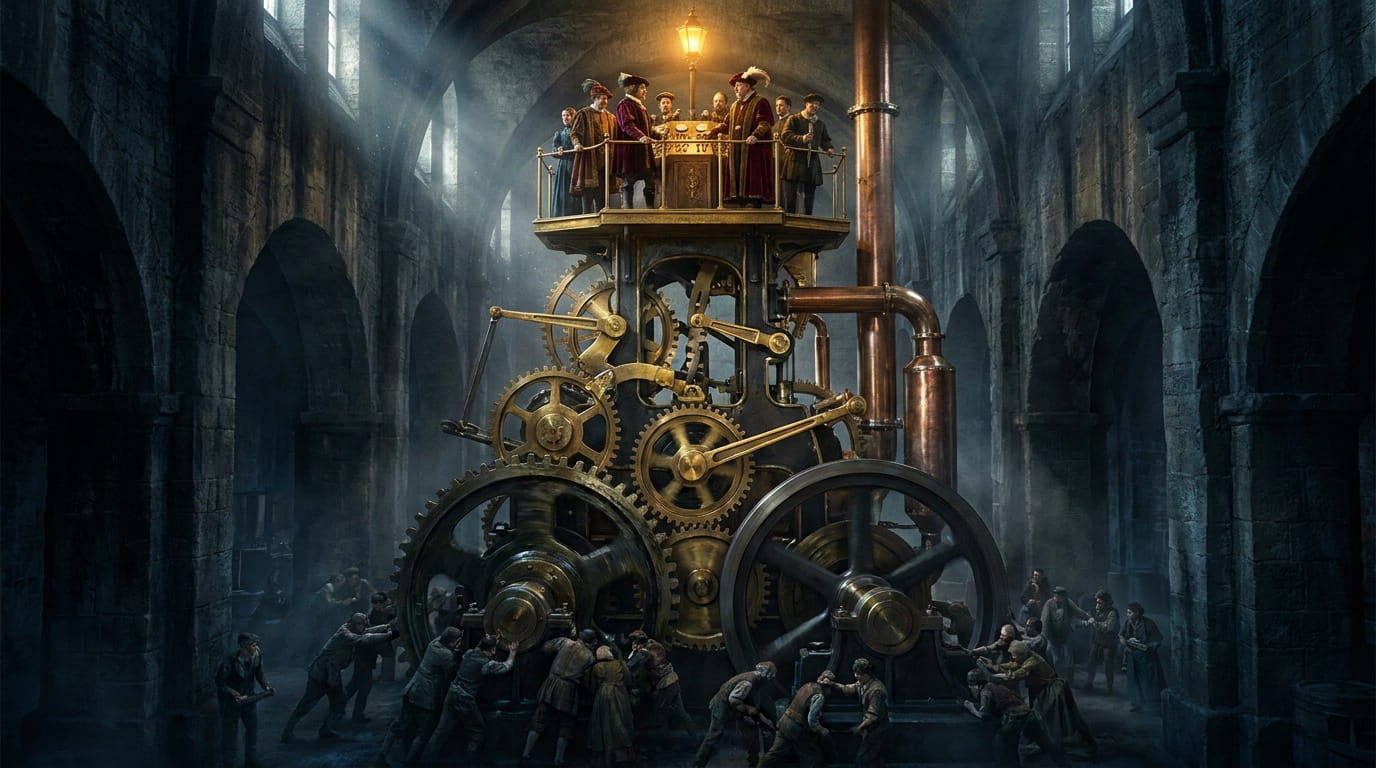
Lord Acton wrote in 1887 “Power tends to corrupt, and absolute power corrupts absolutely”. It has passed 139 years to prove him right and no one has been able to prove him wrong. The pattern is older than nation-states. A group accumulates enough resources to influence outcomes. That influence over outcomes allows them to accumulate more resources. Those resources buy protection for the rules that enabled the accumulation in the first place. The loop closes. An empire forms – not always with flags and armies, but always with the same essential architecture: a small group that extracts value from everyone else, with enough power to make the exploitation look like the natural order of things.
Today’s empires do not call themselves empires. They call themselves corporations, conglomerates, investment funds, and sovereign wealth portfolios. The mechanics are identical. When a handful of asset management companies own controlling stakes in virtually every major airline, bank, retailer, and media company simultaneously, that is not capitalism – it is feudalism with better public relations.
How oligarchies capture democracies
The process is rarely dramatic. It does not require conspiracy. It only requires that money flows toward political outcomes that protect money. A pharmaceutical company funds candidates who oppose drug price regulation. An energy company funds think tanks that question climate science. A technology monopoly hires former regulators who would otherwise oversee it. None of this is secret. Most of it is legal. All of it results in governments that serve shareholders instead of citizens.
The data is blunt: research on US policy shows that the preferences of average citizens have near-zero statistical correlation with actual legislation, while the preferences of economic elites and organized business interests correlate strongly. This is not a democracy. It is an oligarchy with democratic aesthetics – and the United States is far from alone in this.
How empires oppress other countries
The international version is identical in structure and larger in scale. When a multinational controls the cobalt supply chain in the Democratic Republic of Congo, the cocoa supply chain in West Africa, or the lithium deposits in Bolivia, it sometimes doesn’t need an army at all. It needs favorable contracts, compliant governments, and the credible threat of leaving – taking jobs, the investment, and the foreign currency with it. However, when competing countries are after the same resources, military force is used to intimidate and control. Everything under the globalization slogan. Globalization owned by a few.
Why this is not an argument against business
It is an argument against unchecked concentration. A local shop, a national manufacturer, a regional cooperative – none of these have the power to corrupt legislatures or destabilize currencies. The problem begins at the scale where a single company’s decisions affect sovereign nations. That is the scale where ownership needs to change. Corporate concentration corrupts democracies.
The mirror image: when the state becomes the empire
The opposite extreme produces the same architecture. When governments seek to concentrate economic control in the state itself — nationalizing industries, controlling prices, displacing private enterprise — they need money to sustain the project. Where legitimate tax revenue is insufficient and foreign investment retreats, that money increasingly comes from illegal economies: drug trafficking, illegal mining, contraband, and the territorial control of armed groups willing to operate outside the law in exchange for political tolerance.
The mechanism is the mirror image of corporate capture. Instead of corporations buying favorable legislation, criminal economies buy favorable enforcement — ceasefires that allow armed groups to expand, negotiations that legitimize trafficking structures, and a political class that tolerates illicit revenue because it finances the consolidation of state power. Colombia’s Paz Total policy, launched in 2022, is one current example: armed groups granted political status grew an estimated 15% in combatants between December 2024 and July 2025, while cocaine production reportedly exceeded 3,000 tons in 2024 (sources: Accam report cited by InSight Crime, January 2026; UNODC data cited by El País). Venezuela offers a more advanced version of the same trajectory.
The lesson is not that the political left is inherently corrupt, any more than the lesson of corporate capture is that markets are inherently corrupt. The lesson is structural: any system that concentrates decision-making power in a small group — whether that group wears suits in a boardroom or uniforms in a presidential palace — will eventually be captured by whoever can finance its continuation.
The funding source changes. The architecture of exploitation does not.