The Other Empire
Article 1-3
The Other Empire
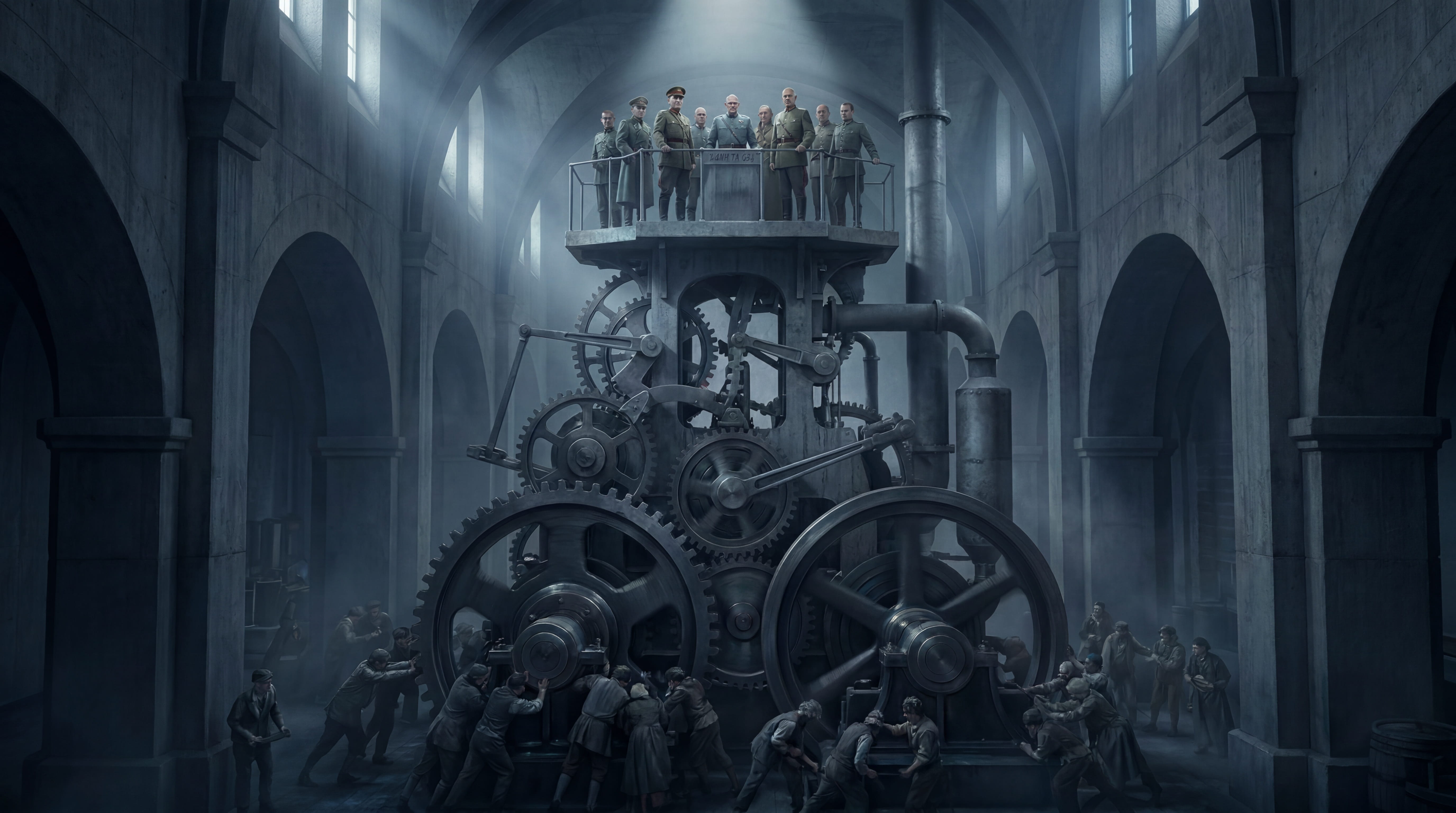
Any proposal to redistribute economic power will be called communist by those who benefit from the current distribution. So let’s settle that here.
This is not communism and the reason matters: communism fails for the same reason corporate oligarchy fails. Both concentrate decision-making power in a small group. Both remove accountability. Both extract value from the many to benefit the few. It is the same architecture wearing a different costume.
There is a specific failure mode that defenders of state-concentrated economies rarely admit. When a state takes control of the economy and displaces private enterprise, the formal economy shrinks. Tax revenue fails. Foreign investment retreats. The regime still has bills to pay – security forces, subsidies, the apparatus of control. So it reaches for whatever funding it can find. And what it finds, almost without exception, is illegal.
Cuba survived for thirty years on Soviet subsidies – roughly $4.3 billion per year between 1986 and 1990, equivalent to about 21% of Cuban Gross National Product (GNP) – and used part of that money to finance armed left movements across Latin America through a dedicated agency called Departamento América (source: Cuba Platform; E.I.A.L. Vol. 28, 2017). When the Soviet Union collapsed, Cuba was rescued by subsidized Venezuelan oil. Cuban Officers provided personal security for deposed President Maduro in Venezuela to make sure he could stay in power and keep subsidizing Cuba. With imposed financial restrictions, Cuba depended on far-left governments in Latin America for its survival. So it invested in tipping the scale for far-left parties to reach power. A regime that promised to liberate the poor of Latin America turned out to be unable to feed its own population without outside benefactors.
Venezuela nationalized industries, dismantled independent institutions, and watched its productive economy collapse. The regime increasingly came to depend on oil sold outside international sanctions, gold smuggling, and operational partnerships with armed groups along the Colombian border to generate hard currency.
Colombia, under the “Paz Total” policy launched in 2022, granted political status and ceasefires to armed groups whose primary business is drug trafficking and illegal mining. The result was the opposite of peace: an internal security report seen by Reuters found illegal armed groups had grown 45% since Petro took office, and by the end of 2025 the think tank Fundación Ideas para la Paz counted roughly 27,000 active combatants – an 84% increase over the three years of the policy, with 5,000 new recruits in 2025 alone (sources: Reuters, 2025; Fundación Ideas para la Paz, “El Deterioro de la Seguridad Marca el Inicio de 2026”). One conflict expert at the National University of Colombia called the peace policy’s failure “total and irreversible.” The state did not become the criminal economy – it bargained with one, and the criminal economies grew stronger inside the bargain.
The same pattern shadows how that power was won. In November 2025 Colombia’s National Electoral Council ruled that Petro’s 2022 campaign exceeded legal spending limits and accepted prohibited financing, imposing the first such sanction against a presidential campaign in the country’s history (source: Consejo Nacional Electoral ruling, November 2025; Petro has called the case a politically motivated coup attempt). Separately, the president’s own son, Nicolás Petro, was charged with money laundering and later confessed that the 2022 campaign received illegal money – including funds traced to Samuel Santander Lopesierra, a convicted drug trafficker – money the prosecution alleges was tied to the promise of peace negotiations for armed groups, though Nicolás maintains the funds never reached the campaign and that his father was unaware (sources: Semana; Fiscalía General de la Nación; InSight Crime, 2024). President Petro has been lax with drug traffickers and keeps pushing to continue with radical changes in both Colombia’s democracy and its economic system.
North Korea is the most extreme. The criminal economy is not tolerated alongside the state – it is the state. According to the Multilateral Sanctions Monitoring Team report of October 22, 2025, North Korean state-sponsored hackers stole more than $3 billion in digital assets over three years, and cryptocurrency theft together with weapons sales to Russia accounted for the majority of the country’s foreign currency earnings in 2024 (source: U.S. Treasury Department, November 4, 2025; Al Jazeera, November 6, 2025). A government founded on the rejection of capitalism now sustains itself by digitally robbing capitalist economies.
Drug money. Smuggling. Foreign subsidies. State-run cybercrime. The funding source changes from one country to the next. The architecture does not.
This is the pattern the far left does not want examined. When you displace the productive economy and call it liberation, something has to pay for the consolidation of state power. What pays for it, eventually, is what would never be tolerated in daylight: the drug trade, the smuggler, the foreign patron with strings attached, the state hacker stealing from the very system the regime claims to oppose.
The proposal in this series is neither the corporate-shareholder model nor the state-ownership model. It is a third path: ownership distributed equally to every human being on earth, with governance designed so no small group can ever capture it – and no shadow economy is ever needed to sustain it.