The Fund's Governance
Article 1-9
The Fund’s Governance
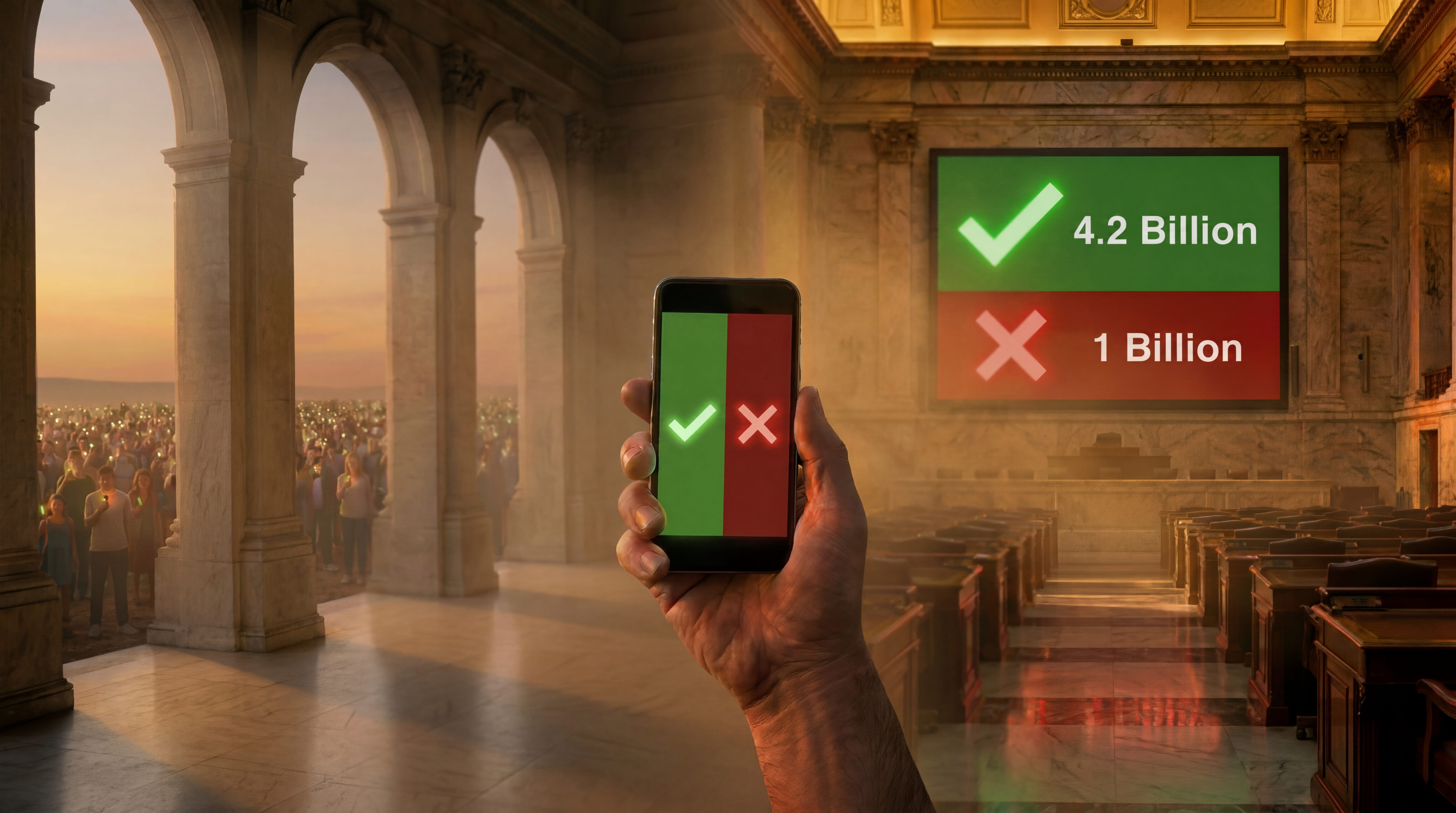
The most important question about any new power structure is not “what does it promise?” but “what stops it from becoming what it replaced?”
Every institution that began as a movement for fairness eventually developed an inner circle. Every cooperative that grew large enough developed managers who served themselves before their members. The pattern is not a failure of idealism — it is a structural problem. When concentrated decision-making power exists, people compete to hold it, and those who hold it tend to use it for their own benefit. The solution is not to find better people. It is to design a system where no small group holds meaningful decision-making power in the first place.
The architecture
The fund has no permanent leadership class. It has an executive layer that executes — legally, operationally, financially — a mandate set entirely by shareholder vote. What industries the fund enters. What profit margins it targets. What it does with surplus profits. What companies it acquires next. These decisions are not made in a boardroom. They are made by every shareholder, through AI-facilitated voting that meets people where they are: voice interfaces in local languages, SMS in areas with limited data, messaging apps in urban centers, and dedicated apps wherever infrastructure supports them.
But “everyone votes” raises an immediate question: what stops the largest population blocs from dominating every decision? Asia holds roughly 58% of the world’s population. China and India together account for about 35%. A simple global majority would mean two countries effectively co-govern the world economy. That is not democracy. That is demographic capture.
The architecture answers this with a bicameral structure.
Two chambers, two principles
Every fund decision must pass two chambers, each grounded in a different principle of legitimacy.
The Citizen Chamber votes by global one-person-one-vote. Every shareholder, regardless of country or contribution level, has equal weight. This chamber represents the moral principle that every human being is equal — the foundation the fund is built on.
The Country Chamber votes by one-country-one-vote by calculating the majority citizen vote of each country. Each of 194 countries casts a single vote, determined by the internal vote of that country’s shareholders, run through the fund’s own AI infrastructure to ensure independence from government interference. This chamber represents the principle that no country, regardless of population, should be steamrolled by larger neighbors.
A proposal becomes a fund decision only if it passes both chambers. The Citizen Chamber prevents tiny populations from imposing their preferences on the world with their country’s vote. The Country Chamber prevents the largest populations from imposing theirs with their citizens vote. Neither chamber can act alone. Both must agree.
This is the structural answer to capture: not better rules, but two different majorities, each required to convince the other before any decision becomes binding.
When the chambers disagree
Two chambers will not always agree. The architecture handles disagreement through a three-stage cascade designed to be transparent, time-bounded, and binding.
Stage 1 — AI-mediated compromise (14 days). The AI governance layer analyzes where the chambers agreed and where they diverged, then generates three compromise alternatives, published openly with full reasoning. Both chambers vote again. If any compromise achieves majority approval in both, it passes. Most disagreements resolve here, because most disputes are about degree rather than direction.
Stage 2 — Mediation period (45 days). If no Stage 1 compromise passes, a public deliberation period opens. The disagreement is explained in plain language in every major language. Minority positions receive equal airtime. Independent rotating analysts publish consequence assessments. AI-facilitated forums collect arguments from shareholders globally. At the end of 45 days, both chambers vote again — on the original proposals plus any new options that emerged.
Stage 3 — The proposal fails (default). If after Stage 2 the chambers still disagree, the proposal is rejected and cannot be reintroduced for 12 months.
This last rule is the most important one. The fund is not obligated to act on every proposal. It is obligated to act only with broad legitimacy. A decision that cannot achieve both popular and country-level support should not be made — and forcing it through with overrides or joint sittings would defeat the entire reason for having two chambers. Better to delay than to capture. The 12-month cooling-off ensures the next attempt is substantively different rather than a war of attrition.
Why AI works here
The AI layer performs three functions: it synthesizes the relevant information about each decision into plain, accessible language in any language; it presents options without advocacy or bias; and it collects and cryptographically verifies votes at scale. The AI does not decide. It informs and tallies. The decision belongs to the 8 billion.
This model has precedent. Iceland’s 2011 crowdsourced constitutional process demonstrated that citizens can meaningfully participate in complex governance decisions through digital platforms, across demographic and geographic lines. That was a national experiment with limited technology. The fund’s AI layer does at global scale what Iceland proved was possible at the national level.
The one structural risk — and its answer
The AI system itself is the one remaining point where a small group could exert disproportionate influence — by shaping how information is presented or how the model is trained. The answer: open-source AI with publicly auditable training data, and a rotating technical oversight committee elected by shareholders on fixed, non-renewable terms. No individual or group interacts with the AI governance system more than once in any leadership capacity.
The constitutional layer
Some rules are not subject to either chamber’s normal vote. These are foundational principles embedded in the fund’s charter:
Dividends always distribute strictly equally per shareholder. No region or country may receive disproportionate manufacturing allocation per capita. The fund will never exceed a defined ownership ceiling in any single industry. Profit margins on essential goods — food, medicine, water, housing — are capped at a defined level. The AI governance system must remain open-source with publicly auditable training data.
Modifying any constitutional rule requires a global supermajority: 75% approval in both chambers, plus majority approval in five of the six continental regions. This makes the foundational rules effectively permanent. They protect the smallest shareholders from any majority, however constituted.
What management actually does
Fund management executes shareholder mandates. It discloses all financial information publicly in real time. It operates under fixed terms, recall votes, and strict conflict-of-interest rules. Its power is operational, not directional. The board does not set the agenda — it fulfills it.
The natural resources question revisited
For countries whose citizens own their natural resource companies: those companies operate under the same governance principle. Citizens of that country vote on extraction rates, pricing policy, and environmental standards. Governments regulate and tax. The resource companies sell to the fund’s manufacturers at fair market prices negotiated transparently. No minister decides the terms in a private meeting.
This is not utopian hope. It is an engineering specification. The tools exist. The precedents exist. The will is the variable.
Join. Share. Build.